Tela Maize
by admin
Maize is the most widely grown food crop in Africa with more than 300 million people depending on it as their main food source. Its production is however severely affected by drought and insect-pests, which negatively impact yields leading to crop failure, hunger and poverty. Identifying ways to mitigate drought risk, stabilize yields, and encourage small-scale farmers to adopt best management practices is fundamental to realizing food security and improved livelihoods for the continent. Through the support of the Bill and Melinda Gates Foundation and the United States Agency for International Development, AATF is leading the TELA Maize Project, a public-private partnership that is addressing the problem of drought in maize and destructive insects specifically stemborers and fall armyworm. Stemborers reduce maize production in several countries in Africa; and in Kenya alone, this loss averages 13% or 400,000 tonnes per year equivalent to USD 90 million. Similarly, projections estimate that the Fall Armyworm could destroy up to 20 million metric tons of maize in Africa each year, enough to feed 100 million people. The TELA Project is working towards commercialisation of transgenic drought-tolerant and insect-protected maize varieties to enhance food security in Sub-Saharan Africa. The word ‘TELA’ is derived from the Latin word TUTELA which means ‘Protection’.The TELA Maize Project builds on progress made from a decade of excellent breeding work under the Water Efficient Maize for Africa (WEMA) Project. The TELA Maize Project is currently implemented in 7 countries – Ethiopia, Kenya, Mozambique, Nigeria, South Africa, Tanzania and Uganda.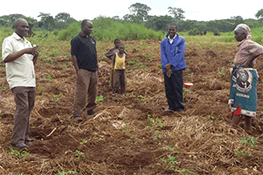

CALL US TODAY
254-20 422 3700
254-20 422 3700

NAIROBI, KENYA
Naivasha Rd
Naivasha Rd

EMAIL
aatf@aatf-africa.org
aatf@aatf-africa.org